
Leading development of convincing practices in mathematics classrooms: Ideas for mathematics leaders’ professional learning activity
It is really pleasing to see a greater focus on the role of the Proficiencies in the teaching and learning of mathematics in primary classrooms. At our recent MTLC conference for Primary Mathematics Teachers at Australian Catholic University (Melbourne Campus), we had eight workshops that ran during the day that specifically focused on the proficiencies of Understanding, Fluency, Problem Solving, and/or Reasoning. During that conference, I also presented a workshop on ways that teachers can highlight convincing in their mathematics lessons. In this post, I share some of my thoughts about this aspect of reasoning from a mathematics leadership perspective.
When it comes to teaching mathematics content, ideas, and knowledge, we need to ensure that the proficiencies, those important ways of thinking and working mathematically, are also taught in our classrooms. As mathematics leaders, it is important that we provide professional learning (PL) opportunities for our teachers that support their understanding of how to teach mathematical content along with the proficiencies for learning that content; both of these aspects of the curriculum are as important as each other. A way to start this focus on the proficiencies in your PL leadership activity could be through an exploration of convincing with your classroom teachers.
Defining and exploring convincing
Although not specifically mentioned in the Reasoning description within the Australian Curriculum documentation (ACARA, 2016), convincing is an important aspect of reasoning. It is a vital way of thinking and working mathematically. As mathematics leaders, our role is to influence the knowledge, practices, and dispositions of our classroom teachers through professional development. Exploring what convincing “looks like”, “sounds like”, and “feels like” in mathematics is one way of influencing the teaching of mathematics in classrooms. This exploring should lead to understanding, and a nice place to start is with a definition for convincing.
Through my reading, I have come to define convincing in mathematics as: a way to communicate mathematical reasoning (thinking) through discussions where evidence is used to persuade others’ reasoning and thinking, and thus supporting mathematics learning. Within this definition, it is assumed that our students take the lead in those discussions, which we can also call arguments. An argument in a learning situation is a form of discussion where all involved in that discussion seek to learn by engaging in practices such as explaining, elaborating, reasoning, and reflecting (Andriessen, 2006). I believe that these definitions for “convincing” and for “argument” are ones that work for teachers and students. I have actually shared these definitions with students in classrooms. They appeared to engage with the idea of a convincing argument really well (once, of course, we had clarified that a mathematical argument is a lot different to an argument outside of the classroom!)
Supporting convincing arguments by using the VLS framework
Within my definition of convincing, I mention the term “evidence”. Evidence is vital when we wish to persuade or convince others of our mathematical reasoning. It is important that as mathematics leaders we help our teachers to understand that evidence is important, and that they need to “keep a press” on students to create these evidence sources of reasoning.
One way that we can explore this need for evidence for convincing arguments is through visual, language, and symbolic representations of mathematical thinking. These three representations formed the basis of a framework which I developed from my work with leaders and teachers, and with my colleague, Leonie Anstey.
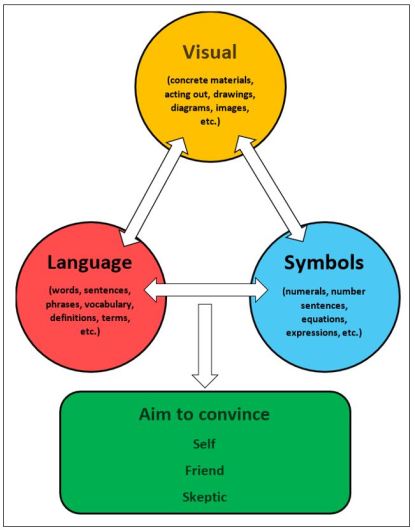
Figure 1. The Visual, Language, and Symbol (VLS) framework
This framework named the Visual, Language, and Symbol (VLS) framework (see to Figure 1) is influenced by the work of Fuson et al. (1997), Lesh, Post, and Behr (1987), and Mason, Burton, and Stacey (2010). The idea captured in this framework is that when engaging in substantive mathematical tasks, we create evidence of our mathematical reasoning using visual, language, and symbol representations. We then use that evidence to convince ourselves first (easiest convincing), then a friend, and then finally, a sceptic (most difficult convincing). Through the convincing process, further understanding of mathematics is then co-created together with others through reasoning discussions or arguments. During those levels of convincing, our reasoning might be expanded, refined, and/or adjusted.
Exploring the VLS framework with teachers in professional learning opportunities
I believe that this framework has the potential to be used by mathematics leaders in their PL leadership activity with classroom teachers. For teachers to use an idea in their own classrooms, they need opportunities to explore that idea with their colleagues first. One of the characteristics of effective mathematics PL is that teachers undertake the role of the learner in the session, workshop, or meeting. This is a time when teachers can understand how mathematical knowledge is constructed, verified, and evaluated.
In terms of exploring the VLS framework, it is also a time when teachers can use the framework and see for themselves its use in supporting convincing practices. By using the framework in a PL opportunity, teachers can be better prepared for using it with their own students. Teachers are more likely to use the framework when they have had the appropriate amount of time to explore how it might be used with their colleagues first. For other teachers, they might need to observe you or their colleagues using the VLS framework during a mathematics lesson. For some of your other teachers, they might benefit from a co-teaching situation with you as their mathematics leader.
One of the important aspects of the VLS framework is that engagement in convincing arguments is best facilitated through the use of mathematical tasks where students can learn substantive mathematics. Richard Elmore, a well-known educationalist, has been known to share the phrase “task predicts performance”. This phrase, which is sound advice for any teacher of mathematics, means that if we only give students worksheets, “drill and practice” activities or lists of mathematics facts to memorise, then students are not encouraged to understand the need for mathematical arguments. They have diminished opportunities to learn how to reason in a mathematical way. The VLS framework works best when students have the opportunity to engage in challenging mathematical tasks where they can learn important mathematics content and important ways of thinking and working mathematically.
Ideas for professional learning about the VLS framework
In this next section, I offer some ideas to mathematics leaders for PL opportunities where teachers can explore the VLS framework. These are in no particular order and nor are they prescriptive. I offer them as a guide for those mathematics leaders who are keen to promote convincing practices in their schools. These ideas are best enacted in a PL workshop or meeting which is designed and facilitated by the mathematics leader.
It is also important that teachers have opportunities to take on the role of the mathematics learner and the mathematics teacher in your PL sessions. I offer too many ideas for the one PL opportunity, so there is the potential for you to explore these ideas over a number of sessions. I would be keen to hear from you if you take up, use, and expand upon any of these ideas in your own PL leadership activity.
- Ask teachers to create convincing arguments for mathematical statements where they decide if the statement is “always true”, “sometimes true”, or “never true”. Ask the teachers to think about the statements, and then ask them to create evidence of their reasoning using visual, language, and symbol representations. Encourage your teachers to think and work by themselves first, and then work with a colleague to adjust or expand their convincing argument. Then they engage in a convincing argument where you and the other teachers play the sceptic, forcing your teachers to refine their mathematical arguments.
- Examples of mathematical statements
- The sum of two even numbers is an even number
- Division leads to a smaller number
- Multiplying a number by itself leads to a product which is larger
- A square is a rectangle
- Examples of mathematical statements
- Reflect on the responses to the mathematical statements and share the different representations that the teachers used to convince themselves and others. Engage teachers with questions where they decide which representations were more appropriate than others, how all three representations matched and aligned (or how they might become more aligned), which statements were the most challenging and why, and what are the accurate responses to those mathematical statements
- Explore how the mathematical statements could be adjusted so that they are always true. Ask the teachers to create statements that they could use with their own students, where students need to engage in convincing practices using all three representations in attempts to convince themselves and others
- Ask teachers to reflect on what convincing “looks like”, “sounds like”, and “feels like”. This is best done when teachers have engaged in mathematical tasks where they have used the VLS framework. Now that they know this about convincing, identify implications for their teaching and for student learning about convincing in mathematics lessons at your school
- Share copies of the VLS framework, and ask teachers to discuss what ideas are conveyed in the framework, and how they enacted those ideas when creating their convincing arguments. Decide on ways of incorporating the VLS framework into teachers’ planning, teaching and assessment
- Ask teachers to provide definitions for convincing in mathematics. Compare and contrast their definition with the one shared in this blog post. Discuss with teachers, “Why is it important that students seek to convince themselves, then a friend, and then finally a sceptic?” “Why is it important that we are now asking our students to respond to mathematical tasks using visual, language, and symbol representations?”
- Explore with the teachers what they think students would do at each convincing level (convince yourself, convince a friend, and convince a sceptic). For example, what do we do when we attempt to convince ourselves? What specific actions do we undertake? What do we do when we convince our mathematical friend, and how is this different from convincing a sceptic? What specific actions do we undertake when convincing the sceptic? Discuss with teachers how they can support their own students to understand the levels of convincing and the actions required at each level (for most engagement with this task, it is best that teachers engage their students in the convincing levels and then debriefing afterwards with the students)
- Focus on the Reasoning description in the Australian Curriculum, paying attention to the verbs. Ask teachers to reflect how students could enact the Reasoning proficiency through the use of the VLS framework. Identify which aspects of the Reasoning description are enacted when students engage in convincing practices. Encourage teachers to identify teacher actions that promote that proficiency enactment in their mathematics lessons
- Brainstorm ideas of how to introduce and use the VLS framework in classrooms from Foundation to Year 6, with attention and focus on how students use the framework to support their own mathematics learning. Discuss ways of sharing and highlighting the VLS framework in classrooms (possibly through mathematics learning walls)
- Use the VLS framework at each PL opportunity where you ask your teachers to engage in a mathematical task. Reflect on the task in relation to the evidence (the three representations of visual, language, and symbol) that they create. Discuss implications for mathematics teaching in the classroom, and ask teachers to set specific actions and enact them
- Ask teachers to bring in evidence of their use of the VLS framework and share success stories of their own teaching and their students’ learning where the framework was used to support convincing practices in classrooms
These are only a few suggestions for mathematics leaders who are keen to establish a greater focus on convincing in mathematics lessons in their schools. If you are interested in accessing the article that I wrote for the May MTLC conference where I share further thoughts about the VLS framework, please feel free to email me. This article provides further background and advice on using the VLS framework and how it might be used in classrooms. Please email me at leadmemaths@gmail.com
You can access the VLS poster which could be used in the classroom using the following link:
I will be presenting a workshop on the VLS framework at the MERGA Teachers’ Day on 29th June at Curtin University, Perth. If you are attending my workshop, I would love to hear from you.
If you are interested in attending any of our MTLC conferences at ACU (Melbourne Campus), please use the following link: www.acu.edu.au/mtlc
References
Andriessen, J. (2006). Arguing to learn. In K. Sawyer. (Ed). The Cambridge handbook of the learning sciences. (pp. 443-459). Cambridge, England: Cambridge University Press.
Australian Curriculum, Assessment and Reporting Authority. (2016). The Australian Curriculum: Mathematics. Canberra, Australia: ACARA.
Fuson, K., Wearne, D., Hiebert, J., Murray, H., Human, P., Olivier, A., Carpenter, T., & Fennema, E. (1997). Children’s conceptual structures for multidigit numbers and methods of multidigit addition and subtraction. Journal for Research in Mathematics, 28(2), 130-162.
Lesh, R., Post, T., & Behr, M. (1987). Representations and translations among representations in mathematics learning and problem-solving. In C. Janvier (Ed.), Problems of representation in the teaching and learning of mathematics (pp. 33–40). Hillsdale, NJ: Erlbaum.
Mason, J., Burton, L., & Stacey, K. (2010). Thinking mathematically (2nd ed.). Essex, England: Person.
 LEaDME: Leading Educators and Development in Mathematics Education