
Mathematics leading: “What am I actually supposed to do?”
A newly appointed mathematics leader recently asked me:
So Matt, I’m new to the mathematics leader role at my school. I’m not really sure what I am doing.
How do you lead maths in a school?
This is such an important question because it captures something many mathematics leaders feel but do not always say out loud.
The truth is mathematics leading is complex work.
You might notice I use the term “mathematics leading” rather than “mathematics leadership” throughout this post. This is a deliberate choice, influenced by the work of my colleagues at Griffith University, Professor Christine Edwards-Groves and Professor Peter Grootenboer. Christine and Peter are international experts in the area of middle leading. Their practice-based framing positions middle leading as something actively enacted in schools, done in the moment, through relationships and work with others, rather than as a role or title someone holds. I use ‘mathematics leading’ in that same spirit, foregrounding the idea that this work is active, observable, and directly experienced by others in the school community.
Often, people take on mathematics leading because they are strong classroom teachers or because they care deeply about mathematics teaching and learning. Soon, though, they find themselves leading meetings, supporting colleagues, managing resources, talking with principals, analysing data, responding to school priorities, and trying to improve mathematics teaching across a whole school.
It can feel difficult to know where to begin and what to prioritise and enact.
For a long time, mathematics leading work was often described in terms of two broad ideas: leading and managing. While I still think those ideas matter, my recent research has led me to think about the work in more connected ways.
At the moment, I think mathematics leadership work can be understood through three interrelated dimensions:
- relational work
- developmental work
- managerial work
Importantly, these dimensions are not enacted separately or in equal amounts. Mathematics leaders move across and through them constantly, often within the same conversation, meeting, or teaching episode.
Relational work
Relational work is enacted through leading actions that focus on practising relational trust through relationships with colleagues for and about mathematics teaching and learning.
In practice, this can look like:
- listening without judging to teachers’ experiences with mathematics
- creating safe spaces for colleagues to discuss practice challenges
- recognising professional vulnerability, including mathematics anxiety and mathematics teaching anxiety
- sharing your own stories of practice and your own “journey” of developing teaching practice
- building trust through collaborative decision-making rather than imposing demands
One of the important things I have come to understand is that mathematics leading is deeply relational work. Teachers are far more likely to engage in professional growth when they feel and know that they are respected, supported, and safe to take risks.
Developmental work
Developmental work is enacted through leading actions that focus on improving teachers’ wellbeing, practices, and knowledge for impactful mathematics teaching and learning.
This work might involve:
- facilitating planning meetings as professional learning opportunities
- strengthening mathematical knowledge for teaching by using mathematical tasks with colleagues
- modelling teaching approaches in classrooms
- helping teachers choose the best representations when teaching mathematical ideas
- interpreting student thinking and misconceptions, and planning ways to resolve them
- providing feedback about colleagues’ practice, focusing on “what’s working well” and “even better if”
Teachers need to feel that professional learning is something done with them, not to them.
Managerial work
Managerial work is enacted through leading actions focused on managing the resources and conditions that support mathematics teaching and learning, as well as advocating for mathematics as a school priority area.
This can include:
- organising resources and budgets
- coordinating professional learning opportunities in school meeting timetables
- managing school assessment data
- advocating for mathematics within school improvement agendas
- securing time for collaboration between colleagues
- navigating the realities of leading from and within “in the middle”,
Managerial work helps create the conditions for practice development. Mathematics leaders often need to advocate for time, resources, and professional learning opportunities to ensure mathematics teaching remains visible and valued in busy school contexts.
When the dimensions become disconnected
One of the challenges in thinking about mathematics leading through relational, developmental, and managerial work is that we can accidentally reduce these dimensions to simplistic ideas.
Relational work is not simply “being nice”.
Developmental work is not simply “pushing improvement”.
Managerial work is not simply “doing admin”.
There can be risks when one dimension becomes over-privileged or disconnected from the others.
For example, in an effort to preserve relationships, mathematics leaders might avoid conversations that support the development of teaching practice. Knowing that a teacher experiences mathematics anxiety does not mean lowering expectations for mathematics teaching. Rather, it means thinking carefully about how relational trust can support capability building and professional growth.
Similarly, developmental work can become problematic if we push too hard on improving practice without attending to ways of practising relational trust. Teachers need to feel supported and respected if professional growth is going to be meaningful and sustainable.
I think this is where mathematics leading becomes nuanced work. We practise relational work whilst undertaking developmental work. A mathematics leader might say:
I know that you have shared your maths anxiety with me, but we agreed that we would teach the lesson in the way we planned together. What aspects of the lesson feel easier to teach, and what do we need to do together to build your capability in the other aspects?
That conversation is simultaneously relational and developmental.
Managerial work can also become disconnected from practice if mathematics leaders spend too much time away from classrooms and developmental conversations about mathematics teaching and learning.
Early in my own mathematics leading journey as a numeracy coordinator, I remember spending a great deal of time in the mathematics resource room auditing and organising resources. If I am honest, that work felt safe. I could make the cupboards look organised and productive. It felt manageable.
At one point, however, my principal told me she was not really seeing or experiencing my mathematics leadership practice.
That conversation has stayed with me for many years.
Managerial work matters. However, if it becomes disconnected from relationships, classroom learning, and the development of mathematics teaching practice, there is a risk that we stay in “safe” spaces rather than engaging in the more courageous work of influencing mathematics teaching and learning; the primary goal of mathematics leading in schools.
An important idea to hold from this blog post is that the work dimensions of mathematics leading interact constantly.
So…how do you lead maths in a school?
There is no simple checklist answer to that question.
Mathematics leading involves strategically enacting relational, developmental, and managerial work in ways that respond to your school context, including colleagues’ mathematics teaching practices, students’ learning strengths and areas for development, school improvement goals, and the systemic mandates and priorities schools are required to navigate.
Relational trust creates the conditions and spaces for professional growth.
Developmental work strengthens mathematics teaching practice and knowledge.
Managerial work helps create the conditions that enable relational and developmental work to happen sustainably.
I attempt to capture these interconnected dimensions of mathematics leading in the triangle below. Although the partitions appear equal, the work is not enacted through equal distribution. Mathematics leaders move responsively across relational, developmental, and managerial work to meet the needs of their school communities and the demands of practice.
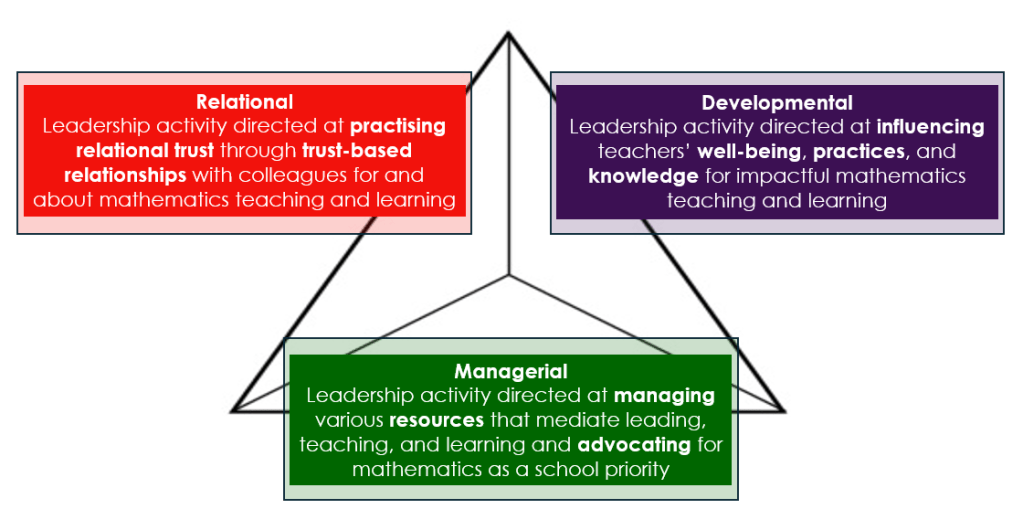
When these work dimensions interact purposefully, they can strengthen mathematics teaching and learning across a school.
So, if you are new to mathematics leading and wondering whether you really know what you are doing, I want to reassure you of something:
Most mathematics leaders are still figuring it out, too.
The work of mathematics leading develops through relationships, reflection, action, and experience. It develops by staying close to practice, listening carefully to colleagues, and continually asking:
What matters most for students’ learning in our school right now, and what will I do tomorrow to respond?
If you would like to read more about my research in this area, you can download my MERGA48 conference paper here: https://merga.net.au/wp-content/uploads/2025/08/MERGA47_2025_Sexton_RR.pdf

